

AI-generated image
If you have landed here from another one of these articles wondering what on earth a hexagram is, welcome. This is the one page in the series built to answer exactly that, so every other piece can just get on with its story.
I shared the ideas and what I wanted this page to explain, and I used AI to help shape the writing.
So, what is a hexagram? It is one of 64 six-line figures from the I Ching, an ancient Chinese text that has been read as a mirror for the patterns of change for a few thousand years now. Each hexagram names a season, a shape a life goes through: starting something messy, holding steady in deep water, letting an ending land, coming back to yourself after you have drifted. 64 is not a random number either, it is every possible way six lines can be open or closed, which is really just a tidy way of saying that however specific your week feels, someone has walked this exact shape before you.
Here is what it is not. It is not a personality chart you decode once and carry forever, the way some other systems work. It is not fortune telling, and I do not claim any special access to answer that for you. It is a cycle, not a verdict, which means the hexagram that describes a hard Tuesday this month might describe an entirely different, calmer Tuesday when it comes back around next year. You do not need a birth chart, a reading, or any prior knowledge to use it. You just need 10 honest minutes and a willingness to notice your own patterns.
Why there is a hexagram for today
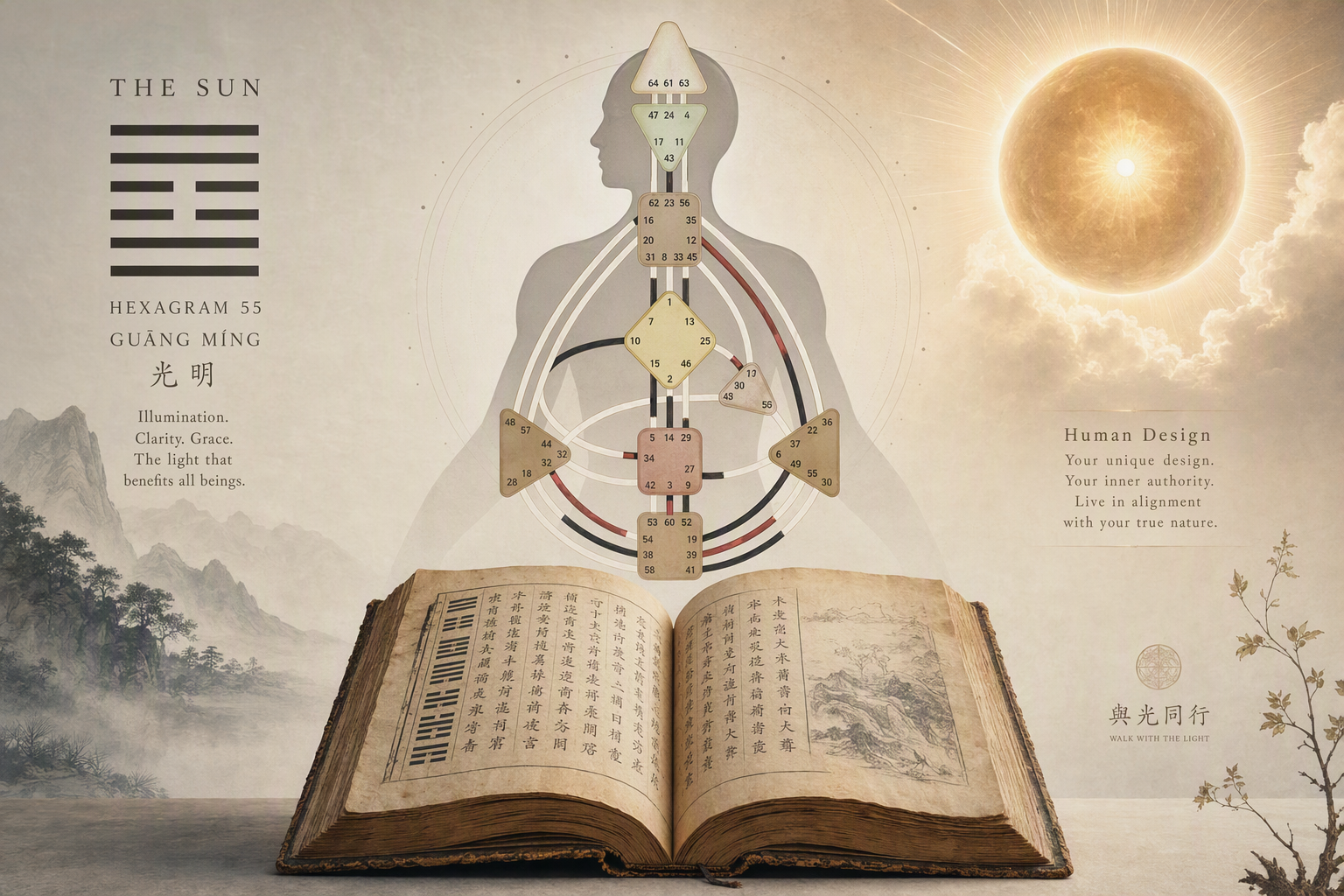
The hexagrams in this practice are not drawn at random. In Human Design, the 64 hexagrams are laid around the zodiac wheel, so each one holds its own small slice of the sky. As the sun makes its yearly path through that wheel, it spends a little under six days in each hexagram, and roughly a day in each of its six lines. So today’s hexagram is simply the one the sun is moving through right now. It is the same for everyone, wherever you are, which is why you never need your own chart to follow along.
What My Daily Return draws on
My Daily Return is a synthesis of three old maps, resting on one steady ground. The I Ching gives the 64 themes and the language of change. Human Design places those themes around the wheel of the year. Astrology follows the sun through that wheel, so the practice moves with the actual sky. Underneath all three sits A Course in Miracles, which shapes how every reflection is written: not a problem to fix, but a perception to soften, and a quiet choice between fear and peace you get to make again each morning.
How the six lines work
Each hexagram carries one core theme. Its six lines are six different chapters of that same theme, not six separate ideas. Think of the hexagram as what the season is about, and each line as how that season actually shows up on a given day. The same six-part arc repeats inside every hexagram.
- Line 1 asks: what do I need to understand before I trust this? The quiet, inward day, gathering your footing before you leap.
- Line 2 asks: what shows up naturally, when I’m not trying? Some part of the theme is just already there in you, and it often takes someone else noticing it before you do.
- Line 3 asks: what do I learn by actually trying this? The trial-and-error day. Not everything works the first time, and that is the point, not the problem.
- Line 4 asks: how does this ripple out to the people around me? The theme stops being private here. It starts moving through your friendships, your family, your actual community.
- Line 5 asks: what practical difference can this make, out in the world? The day the theme gets useful to someone besides you.
- Line 6 asks: what has this taught me about being human? The theme settles into something closer to wisdom here, less something you are working on, more something you have quietly become.
You can watch this exact arc play out across any hexagram’s six days. Take Hexagram 3, Difficulty at the Beginning: Day 1 is Starting Before You’re Ready (the understanding day), Day 2 is Slow Roots, Strong Shoots (the natural, unforced day), Day 3 is Fail Forward, Gently (the trial-and-error day), Day 4 is Let Someone In (the relationship day), Day 5 is Calm Over Control (the practical day), and Day 6 is When You Stop Pushing (the wisdom day). Same theme, six honest angles on it.
So the 384 daily entries in this practice are not 384 unrelated ideas to memorize. They are 64 core themes, each looked at through the same six honest stages: understanding, natural expression, trial and error, relationship, practical use, and quiet wisdom.
Why I am writing this
I did not start writing about hexagrams because I had answers. I started because I needed a practice steadier than my own mood, during a stretch of my life that genuinely unsettled me: leaving a career, then a country, then working out who I was underneath both of those things. Ten minutes with one hexagram a morning became the place I could actually hear myself think. It still is. I am not writing from some finished, arrived-at place. I am still doing this practice myself, most mornings, same as I would ask of you.
The book I built out of this, My Daily Return, walks all 64 hexagrams across a full year, following the sun through every one of them, line by line. It goes much deeper into how the I Ching, Human Design and astrology fit together, and how A Course in Miracles grounds each day’s reflection. It is not out yet, but you can join the waitlist to hear the day it is ready. For every hexagram and line, the book describes its Highest Expression and its Shadow Expression: what the theme looks like when you are living it well, and what it looks like when fear has the wheel. The stories live here instead. These Journal articles pull single hexagrams out of that larger arc and bring them to life: a real story, one honest quote, and one small reflection you can actually do today.
How to use these articles
Each piece here is a story, not a structured entry. There is no shadow line or highest-expression column, that level of detail lives in the book. What you get instead is one hexagram’s theme brought to life through a real situation, something to see yourself in rather than decode. Read it the way you would someone being honest with you over coffee, notice where it lands, and let the reflection at the end do the rest. Take what is useful, leave what is not, and come back to whichever hexagram you need again later.
If this is a place you want to keep coming back to, the free guide, 5 Ways to Trust Your Inner Knowing Again, has more of this, ten minutes at a time, no chart required.